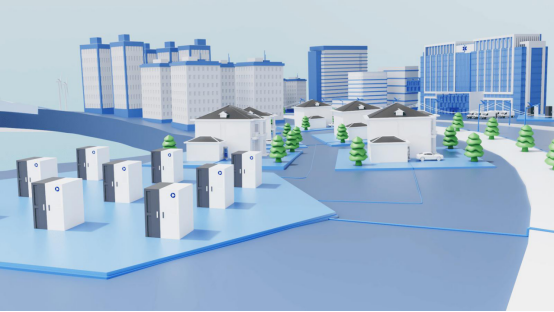
Home energy storage changes household power use by giving owners more control over solar output, backup, and daily consumption. The subject of How Home Energy Storage Is Changing Household Energy Use should be read for business-side customers such as housing developers, installers, channel partners, property energy planners, and residential solution buyers, because residential systems support solar self-consumption, backup power, and more transparent home energy control. Public HiTHIUM materials support a review that starts with application needs and then studies the related products and storage solutions for buyers comparing residential energy storage systems options in household energy use work. The commercial question behind residential energy storage systems is whether storage can perform the assigned duty with predictable safety, controllability, and support in household energy use projects. That is why residential energy storage solutions should be examined through project evidence rather than treated as a simple marketing label.
Operational Conditions Behind the Storage Decision for Household Energy Use
During product qualification, the first useful step is to describe the storage duty before naming equipment sizes or supplier categories in household energy use projects. For household energy use, that duty can involve home backup, photovoltaic self-consumption, time-of-use shifting, and neighborhood energy resilience, while the surrounding constraints may include incorrect capacity sizing, poor inverter matching, unsafe indoor placement, weak monitoring, and unrealistic backup expectations. A technical review of residential energy storage systems can then look at installation environment, battery chemistry, usable energy, protection design, monitoring functions, and homeowner service support without turning the article into a checklist that ignores real operating conditions in household energy use projects. The main point is to make how home energy storage is changing household energy use specific enough for technical review and business approval.
Turning Product Data into Project Confidence in Household Energy Use
For system integrators, specifications need to be converted into operating assumptions that a procurement team can verify. Capacity numbers, control behavior, charging limits, cooling design, fault response, and service intervals must be weighted according to the site where how home energy storage is changing household energy use will be applied. A discussion of residential energy storage systems should therefore include both product information and the conditions under which the product is expected to perform. For this business-side audience, the review has to support a defensible decision on how home energy storage is changing household energy use, not only a technically attractive description.
A Careful Basis for Storage Investment for Household Energy Use
The last check should ask whether the asset can perform the work promised during the earliest project discussions in household energy use projects. That judgment includes technical evidence, commercial suitability, safety behavior, service support, and the ability to adapt as conditions around household energy use change. HiTHIUM should be discussed in relation to those points, with residential energy storage systems and residential energy storage solutions treated as project terms that need proof in application. Rather than accepting a generic storage narrative, stakeholders should build a project-specific case that explains how the equipment will earn its role when residential energy storage solutions appears in a project brief for household energy use.
