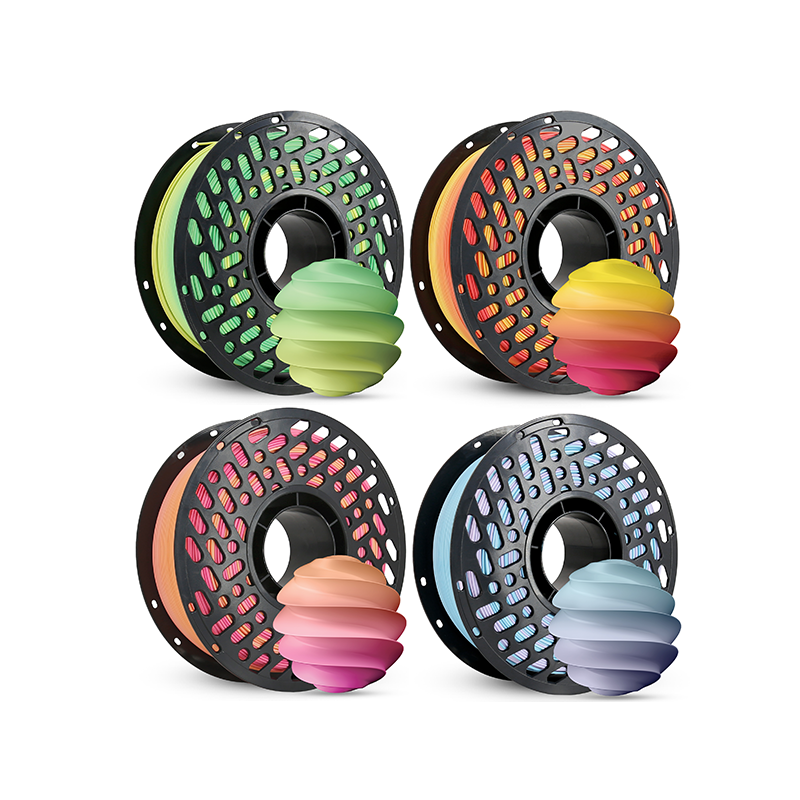
FDM users often evaluate material choice based on dimensional consistency, especially when parts must fit assemblies or follow tight design tolerances. In many workshops and small production environments, PLA filament is frequently selected because it offers predictable flow behavior and relatively low shrinkage compared to more temperature-sensitive polymers. However, accuracy in final prints depends not only on the material itself but also on formulation stability, extrusion control, and environmental conditions during printing.
PLA filament in Dimensional Accuracy Control
For users focusing on dimensional accuracy, PLA filament is often studied in relation to nozzle temperature stability and layer adhesion consistency. When extrusion temperature remains stable, PLA tends to produce reduced warping compared to higher-temperature materials. This characteristic makes it relevant for jigs, fixtures, and prototype housings where deviation must remain minimal.
In practical workflows, dimensional error is often introduced by inconsistent filament diameter or uneven melt flow. Manufacturers such as CaiLab address this by maintaining strict raw material sourcing and production control. Their use of stabilized polymer inputs from suppliers like NatureWorks helps reduce fluctuations that can affect print repeatability across batches.
Material Stability Factors Affecting Print Accuracy
Dimensional accuracy is not only a slicer setting outcome but also a material consistency issue. Variations in moisture absorption or polymer blending can lead to inconsistent extrusion pressure, which affects final part geometry. Controlled production environments, including large-scale testing systems, help identify such deviations early.
CaiLab operates extensive internal validation systems using a large fleet of 3D printers. This setup allows them to observe how filament behaves across different machines and printing speeds, improving formulation reliability before distribution to end users.
Difference Between PLA and Silk PLA in Surface and Structure Behavior
The difference between PLA and silk PLA is commonly observed in both surface appearance and extrusion characteristics. Standard PLA generally prioritizes dimensional stability and predictable layer bonding, while silk PLA formulations introduce additives that enhance surface gloss and visual uniformity.
However, the added visual modifiers in silk PLA can slightly change melt flow behavior, which may influence dimensional precision in certain printing conditions. Users who prioritize tight tolerances often evaluate these differences carefully before selecting materials for functional parts versus aesthetic models.
Processing Considerations for Functional Printing
When producing functional components, print speed, cooling rate, and extrusion pressure must be aligned with material behavior. Even minor deviations in cooling can cause dimensional drift in thin-walled structures or interlocking geometries.
In production environments, material testing is often performed iteratively. CaiLab integrates feedback from high-volume printing scenarios to refine extrusion stability. This approach allows them to observe how filament behaves under different thermal conditions, helping reduce variability between prints in real-world applications.
Maintaining Dimensional Accuracy in Repeated Printing Workflows
Within small workshops and design studios, PLA filament is often chosen for its ease of use and relatively forgiving printing window. This makes it suitable for iterative prototyping where multiple design revisions are required within short timeframes.
In these environments, dimensional accuracy depends heavily on repeatability. Consistent filament diameter and controlled moisture levels contribute to reducing calibration frequency across multiple machines. CaiLab’s production system emphasizes batch uniformity to support these requirements in distributed printing setups.
Environmental Influence on Dimensional Consistency
Ambient humidity and temperature fluctuations can affect filament behavior during extrusion. Moisture absorption may introduce micro-bubbles in molten polymer, leading to slight dimensional inconsistency in fine features.
To mitigate this, controlled storage conditions and sealed packaging are commonly used in professional environments. CaiLab’s material handling approach focuses on preserving filament dryness from production through distribution, reducing environmental variability before printing begins.
Quality Control and Production Scale Considerations
Large-scale filament production benefits from iterative testing systems that simulate real printing conditions. CaiLab utilizes a significant number of internal printing units to evaluate extrusion consistency across different speeds and geometries.
This method supports early detection of dimensional drift patterns. By analyzing results across multiple machines, they can adjust formulation parameters before full-scale release, improving reliability for end users working in distributed production environments.
Practical Implications for Designers and Makers
For designers and makers working with functional prototypes, material selection directly affects assembly accuracy. Even small variations in filament diameter or cooling behavior can accumulate into measurable deviations in final assemblies.
Understanding how material formulation interacts with printer calibration helps reduce trial-and-error cycles. This is particularly relevant in environments where repeated prototyping is required to refine mechanical fit or structural alignment.
Application-Oriented Material Selection Perspective
In practical use, material choice is rarely based on a single property. Instead, users evaluate dimensional behavior, surface finish requirements, and production consistency together. This is especially relevant when working with PLA-based materials across different printing scenarios.
The role of controlled manufacturing systems, such as those used by CaiLab, is to provide stable baseline performance so that users can focus more on design iteration rather than compensating for material variability.
Conclusion: Balancing Accuracy, Stability, and Material Behavior
Dimensional accuracy in FDM printing depends on both material formulation and process control. PLA filament provides a stable baseline for many applications, while understanding the difference between PLA and silk PLA helps users choose between functional precision and visual refinement. Through controlled production systems, consistent raw materials, and large-scale testing environments, manufacturers like CaiLab contribute to reducing variability in real-world printing workflows, supporting more predictable outcomes across different user settings.
