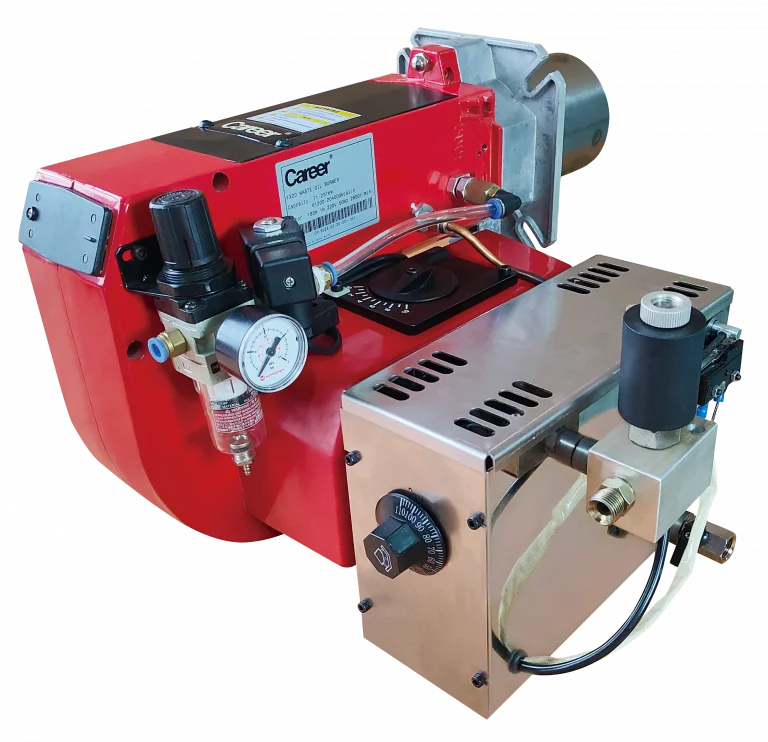
A conventional oil burner and a waste oil burner may both produce heat from liquid fuel, but they are not interchangeable combustion systems. Conventional units are generally designed around cleaner, more predictable fuels such as diesel, kerosene, or Bio 10 oil.
Waste oil can contain varying viscosity and contaminants, so its burner must prepare the fuel differently before stable ignition can occur. The real difference is how the combustion system manages fuel condition, atomization, ignition, and residue.
How Does Fuel Condition Change the Burner Design?
Clean light oils have relatively consistent physical properties, allowing a conventional burner to meter and atomize the fuel through a pressure-based nozzle arrangement. The equipment can focus on maintaining the required fuel-air ratio and flame pattern under known conditions.
Waste oil presents a less uniform feedstock. Used motor oil, cooking oil, transmission fluid, and hydraulic fluid are identified for dedicated waste-oil equipment. Their viscosity and contamination levels can vary, creating a greater need for filtration and fuel conditioning before combustion.
A waste oil fuel burner is consequently designed around fuel preparation as part of the combustion process rather than treating the incoming oil as a uniform commercial fuel.
Why Is Preheating More Important for Waste Oil?
Viscosity directly affects how readily a liquid can be converted into fine droplets. Waste oil can be too viscous for dependable atomization at normal conditions, so dedicated systems use preheating to reduce viscosity before ignition.
Conventional light-oil equipment typically does not need the same level of waste-fuel conditioning. Its design assumes a fuel within the intended operating range. Using fuel outside that envelope can lead to poor atomization, unstable ignition, smoke, deposits, or unreliable operation.
How Do Atomization Methods Differ?
Atomization is another major dividing line. Conventional light-oil burners commonly use pressure atomization, in which fuel is delivered through a nozzle to form a fine spray. The quality of that spray depends on fuel properties and the operating conditions for which the nozzle was designed.
Dedicated waste-oil systems may use siphon or air-assisted atomization to handle more difficult fuel characteristics. Product information specifically identifies siphon-nozzle technology, while the operating description explains that used oil is atomized into fine particles and mixed with air. Both aim to create droplets that mix with combustion air. Waste fuel instead requires the burner to accommodate greater variability.
Does Air Management Also Change the Combustion Process?
Fuel preparation alone cannot guarantee stable combustion. Air must enter in the correct quantity and distribution so the prepared fuel burns in the intended zone. Conventional oil burners can be configured with single-stage, two-stage, or modulation controls, depending on the model and application.
Waste-oil systems also require close control of combustion air, but their fuel-side preparation adds another variable. Flame monitoring and automatic ignition and shut-off are listed among the control features of the referenced waste-oil range. These functions let the system respond to ignition and flame conditions.
Why Does Maintenance Differ Between the Two Burner Types?
Maintenance requirements reflect what enters the combustion chamber. A conventional burner supplied with clean, compatible fuel generally has fewer contaminants to manage. Its service routine can focus on the nozzle, air path, ignition, and flame detection.
Waste oil can introduce water, sludge, debris, soot, and ash, making fuel filtration and component cleaning more important. Maintenance guidance recommends pre-filtering waste oil, checking fuel quality, and cleaning the combustion chamber, nozzles, and air filters.
Nozzle, air-compressor, and fuel-pump condition also deserves regular attention because these components work harder in waste-oil service. That makes a waste fuel burner a specialized system, not simply a conventional unit with a different fuel tank. The waste fuel burner must be selected for the actual condition of the recovered oil.
Which Burner Is Better for an Industrial Heating System?
Neither design is universally better. The choice depends on the available fuel and heating system. Conventional oil burners are the logical fit when a process requires specified light oils and consistent fuel characteristics. The light-oil range covers diesel, kerosene, and Bio 10 oil across a broader capacity range than its waste-oil category.
A waste oil fuel burner becomes relevant when an operation has a compatible and sufficiently conditioned waste-oil stream and wants to convert that material into usable heat. The referenced waste-oil range is designed for applications including furnaces, boilers, and incineration-related systems, with adjustable thermal output reported from 24 to 355 kW on the category page.
What Should Be Checked Before Choosing Between Them?
The decision should begin with fuel analysis rather than burner price. Operators need to establish the oil type, viscosity, contamination, heat input, and existing furnace or boiler configuration. Fuel compatibility should then be matched with the burner’s atomization method, control arrangement, and capacity.
Career Burner presents both conventional light-oil and waste-oil equipment as distinct product categories, reflecting their different combustion requirements. Its waste-oil systems include FX10A, FX20, and FX30 models, while its light-oil range includes multiple diesel and kerosene models. The choice is a combustion-system decision.
Conclusion
The central difference is fuel handling. Conventional oil burners are designed around relatively clean, predictable liquid fuels, while waste-oil burners incorporate additional measures for variable viscosity and contamination. Preheating, filtration, specialized atomization, flame monitoring, and more frequent cleaning can all become part of the waste-oil combustion system.
For an industrial operator, the safest selection is the burner whose fuel-preparation and combustion design matches the actual fuel stream, required heat output, and equipment configuration. Career Burner positions waste-oil equipment as a purpose-built route for turning compatible used oils into usable process heat.
