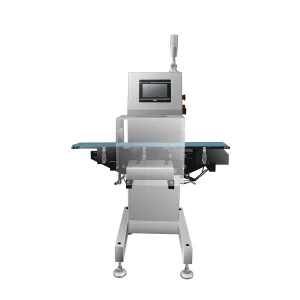
Weight consistency has a direct connection with product quality, portion accuracy, and packaging control. Across high-speed food lines, checkweighers can examine individual packs as they move through production, comparing measured weight with predefined target values and identifying units outside the accepted range. Rather than relying solely on periodic manual sampling, continuous weighing creates a more detailed view of output. Easyweigh combines precision measurement with intelligent data analysis, providing a practical approach to weight control without making inspection the sole focus of quality management.
Weight Control Begins With Measurement
The basic principle is straightforward: each product passes over a weighing section fitted with a precision load cell, where its weight is captured while movement continues. Software then compares the reading with preset upper and lower limits.
Speed creates an important engineering challenge. Products cannot simply stop on the conveyor for every measurement, particularly on lines producing hundreds or thousands of packages per hour. Accurate readings therefore depend on stable product movement, suitable conveyor design, and carefully configured weighing parameters.
Environmental conditions can influence performance as well. Vibration, uneven conveyor surfaces, airflow, moisture, and mechanical interference may affect load-cell readings. Regular calibration and sensible maintenance help distinguish genuine weight variation from disturbances caused by the surrounding production environment.
Why Product Flow Matters
Consistent spacing between packages gives each weighing cycle a clearer measurement window. Crowded products can interfere with detection, while unstable positioning may create inconsistent readings even when the actual product weights are similar.
Product characteristics also deserve attention. Flexible pouches, bottles, cartons, and irregular food portions behave differently as they travel across the conveyor. Their shape, center of gravity, and contact with the belt can all influence measurement stability.
Reject handling forms another important part of the process. Once an underweight or overweight package has been identified, the corresponding unit needs to be diverted without disturbing neighboring products. Appropriate timing and mechanical coordination therefore matter just as much as the initial measurement.
Using Weight Data Beyond Rejection
Weight information can reveal patterns that are not immediately visible during routine production checks. A gradual shift toward heavier or lighter packages, for instance, may indicate changes in filling behavior, ingredient distribution, or equipment adjustment.
Historical records can also help quality personnel compare different production periods. Repeated deviations may point toward a process issue, whereas isolated readings could have a different explanation. Interpreting these patterns adds context to individual inspection results.
Such analysis works best when measurement data remains connected to practical production decisions. Operators can investigate unusual trends, review relevant batches, and adjust upstream processes according to established quality procedures rather than responding only after large quantities have been affected.
Tailoring Checkweigher Hardware and Software to B2B Production Needs
Packaging dimensions, line speeds, and product characteristics differ from plant to plant. A checkweigher that performs well on one line may need adjustments for another. Easyweigh works with B2B customers through OEM and ODM cooperation to align equipment with actual production conditions. Conveyor width, load cell range, reject mechanism, and control interface can be modified during development. Software settings can be localized or integrated with existing plant systems.
Sample testing with real products confirms weighing accuracy before installation. After commissioning, operator training, spare parts, and technical support remain available. As package formats or production volumes change, the system can be updated through software revisions or modular hardware changes. This collaborative approach keeps weight inspection aligned with long-term operational needs rather than forcing the line to adapt to a fixed unit.
Improving Consistency Without Slowing Production
Continuous weighing does not necessarily require production to pause. Inline measurement allows packages to remain in motion, making the approach suitable for automated food-processing environments where throughput is an important consideration.
Nevertheless, higher line speed should not be treated as the only performance objective. Measurement accuracy, product spacing, reject timing, and maintenance requirements must remain compatible with the operating conditions. An aggressively configured line may create more problems if measurement stability declines.
Clear operating procedures can reduce avoidable variation. Calibration schedules, routine verification, belt inspections, and documented response procedures give production teams practical reference points. These measures also make it easier to identify whether an unusual result originates from the product or the weighing process.
Turning Measurements Into Better Quality Practices
Weight control becomes more valuable when its findings are interpreted alongside other production information. Fill-volume records, ingredient usage, packaging data, and batch history can provide useful context when unusual weight patterns appear.
Rather than treating every rejected package as evidence of a major defect, quality personnel can examine the scale of the deviation and its frequency. Such differentiation supports proportionate responses and helps prevent unnecessary adjustments to otherwise stable processes.
The broader role of checkweighers is therefore not limited to separating packages by weight. They provide continuous measurements that can support portion control, process monitoring, waste reduction, and quality investigations. As food manufacturers seek greater consistency without relying entirely on manual sampling, precise inline weighing remains a useful part of production control.
Reliable results ultimately depend on more than the weighing unit itself. Product characteristics, conveyor conditions, calibration practices, operating limits, and staff procedures all contribute to meaningful measurements. Easyweigh places precision weighing and intelligent analysis within this broader quality-control context, showing how measurement data can support practical production management. Used thoughtfully, checkweighers can give food manufacturers clearer visibility into weight variation while fitting naturally into established quality procedures.
