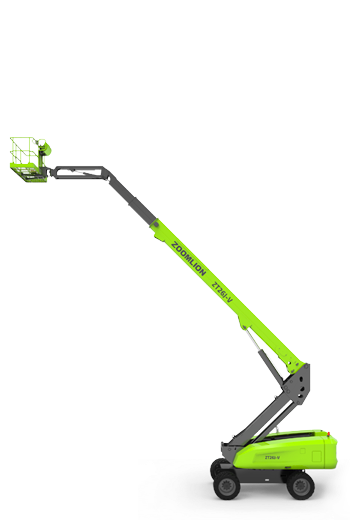
Long-span roof construction and structural installation often require workers to access elevated points across wide, open areas while positioning tools, fasteners, and components. Steel trusses, roof beams, industrial cladding, and overhead connections can be difficult to reach using equipment with limited horizontal outreach.
Selecting the right access platform helps contractors coordinate installation sequences, reduce unnecessary repositioning, and maintain safe working conditions. A telescopic boom lift is well suited to many of these applications because its extending boom can provide direct access to elevated work areas across substantial distances.
For construction companies, the decision should consider working height, site layout, ground conditions, platform requirements, and equipment performance. Zoomlion Access offers diesel-powered equipment such as the ZT26J, designed for demanding outdoor construction and industrial applications.
Extended Reach Supports Large-Scale Structural Work
Long-span structures create access challenges because installation points may be separated by wide roof sections, steel frameworks, or areas where ground-level obstacles restrict equipment positioning. A straight, extending boom allows operators to reach elevated work locations without placing the machine directly beneath every connection point.
This capability is valuable during steel-frame assembly, roof-edge installation, industrial maintenance, and the fitting of structural components. Instead of repeatedly moving equipment to approach each work area, contractors can assess whether a suitable boom position provides access to several nearby tasks. Actual coverage depends on the machine’s working envelope, platform load, and site conditions.
When comparing a telescopic boom lift, project teams should distinguish maximum working height from horizontal outreach. These specifications describe different capabilities, and neither alone establishes whether a machine can reach a particular installation point. Reviewing the manufacturer’s operating diagrams helps planners select equipment that matches the structure’s geometry.
Working Height Must Match the Roof and Installation Sequence
Roof and structural projects often involve several elevations, from lower steel connections to roof beams and upper cladding. Access equipment must provide sufficient height for workers to reach the task while retaining the clearance needed to position the platform safely.
The Zoomlion Access ZT26J is a diesel-powered telescopic boom lift with a maximum working height of 28.7 m. This specification makes it a candidate for evaluating elevated outdoor construction tasks, subject to the required outreach, platform capacity, and operating conditions. Contractors should verify the model’s full technical specifications and working envelope before confirming suitability for a particular structure.
A practical selection process begins with the highest work point and then checks lower installation locations, approach routes, and potential obstructions. Planners should also consider whether workers need to handle tools or materials from the platform. The required payload must remain within the manufacturer’s limits throughout the intended operation.
Boom Rigidity and Smooth Movement Matter During Installation
Structural installation requires accurate positioning near beams, roof edges, and connection points. Excessive movement or poorly controlled positioning can make it harder for workers to align components, use tools, and maintain consistent working practices. Boom design and control systems therefore deserve attention alongside reach specifications.
The ZT26J features a hexagonal boom design intended to provide strong rigidity and anti-fatigue performance. It also incorporates a parallel four-link lifting mechanism for smooth boom movement. These design features are relevant when evaluating equipment for repetitive elevated tasks, although actual performance depends on operating conditions and compliance with the machine’s instructions.
Contractors should avoid treating structural rigidity as a substitute for safe operation. Workers must follow platform loading limits, maintain required clearances, and avoid using the platform to push, pull, or support structural members unless the manufacturer explicitly permits the intended activity. Precise access supports installation work; it does not replace appropriate lifting equipment or engineered installation procedures.
Chassis Performance and Site Conditions Affect Productivity
Large structural projects frequently take place on unfinished ground, where compacted soil, uneven surfaces, and changing access routes can complicate equipment positioning. Chassis steering, traction, and ground adaptation can influence how efficiently a machine moves between work zones. However, contractors must verify surface conditions and follow the manufacturer’s operating restrictions rather than assume that outdoor capability guarantees suitability for every terrain.
The ZT26J specification page identifies four-wheel drive and an oscillating axle system as features that support off-road performance. Zoomlion also lists a 45% gradeability for the model. These characteristics can be useful when assessing access across suitable sloped or uneven work areas, provided the actual terrain, machine configuration, and load remain within approved limits.
Before deployment, site managers should inspect slopes, ground firmness, overhead obstructions, and nearby power lines. The U.S. Occupational Safety and Health Administration recommends work-area inspections, daily equipment checks, trained operators, and compliance with manufacturer load and operating limits. These measures help reduce risks associated with falls, contact hazards, and tip-overs.
Evaluate Power, Controls, and Ownership Costs
Diesel power can be a practical consideration for large outdoor construction sites where equipment must work across broad areas and charging infrastructure may be limited. Nevertheless, fleet managers should evaluate fuel consumption, maintenance access, emissions requirements, noise restrictions, and expected operating hours before deciding which powertrain best suits a project.
The ZT26J includes a load-sensitive system intended to save energy, along with a swing-out engine tray designed to facilitate maintenance. Its standard jib also supports maneuverability, while the platform specification and permitted load configuration should be checked against the work crew’s needs. These details can inform an assessment of productivity and lifecycle costs rather than relying on purchase price alone.
When comparing telescopic boom lift manufacturers, buyers should review verified working-envelope diagrams, platform capacities, service support, spare-parts availability, operator training, and warranty terms. A technically suitable machine is most valuable when it can be maintained and deployed reliably throughout the project.
Choosing Access Equipment for Long-Span Projects
Telescopic boom lifts can offer construction teams a practical way to reach elevated installation points across large structural sites. Their value depends on matching working height, horizontal outreach, platform capacity, chassis performance, and service requirements to the specific task. For buyers comparing telescopic boom lift manufacturers, verified specifications and dependable support should guide the decision. Zoomlion Access’s ZT26J is one option to assess against these project requirements, site conditions, and applicable safety procedures.
