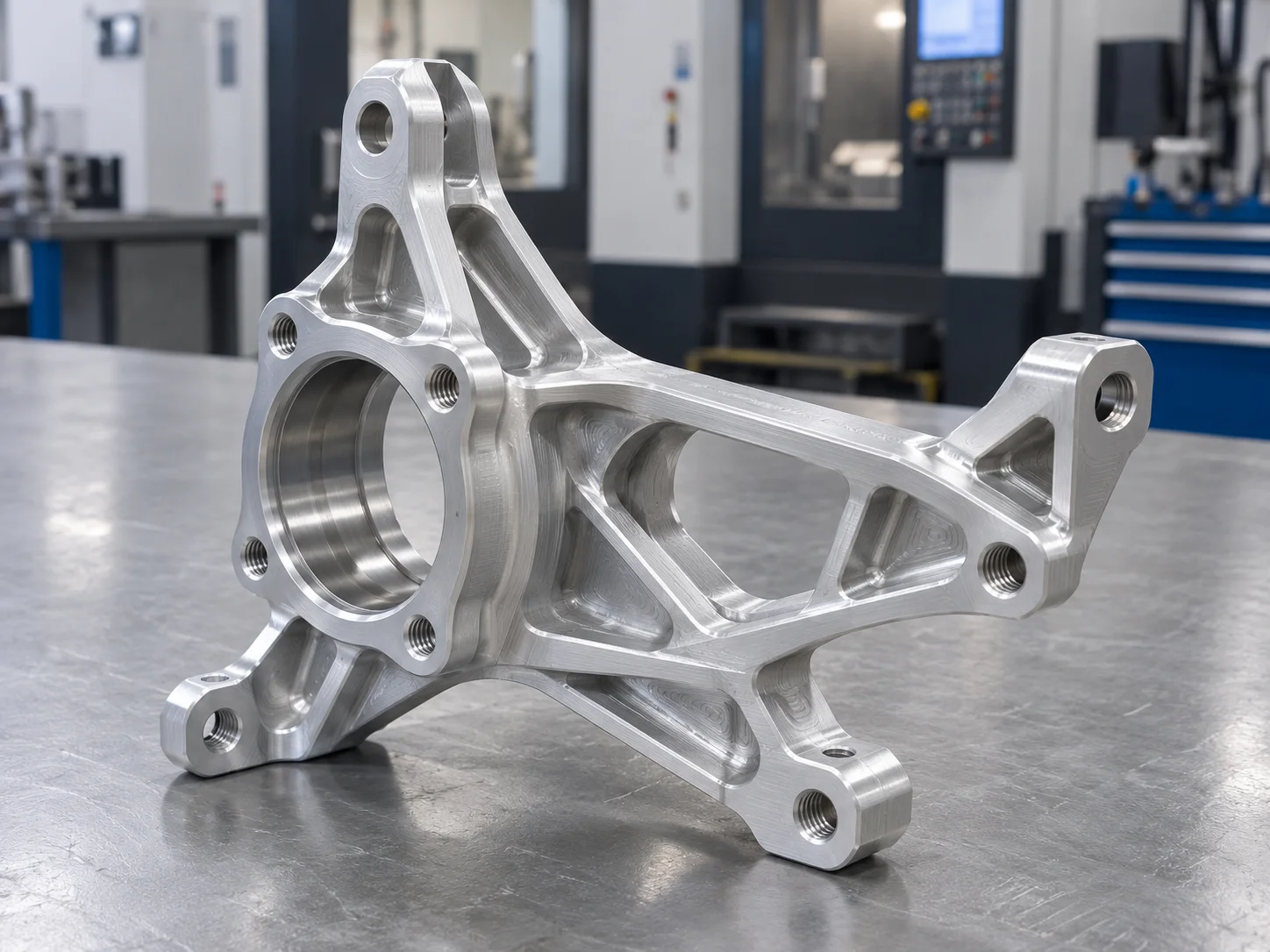
Product development rarely moves from CAD to final production in a single attempt. Engineers may discover an interference issue during assembly, find that a wall needs reinforcement during testing, or adjust a mounting feature after evaluating the first prototype. Each change creates another manufacturing cycle.
For these projects, rapid CNC machining provides a practical way to shorten the distance between prototype, testing, design modification and the next physical part. Because CNC parts are machined directly from digital CAD data, engineers can revise the design and remachine the updated component without redesigning dedicated production tooling. HordRT supports CNC machining for prototypes, low volume production and larger quantities, making the process suitable for product development stages where designs continue to evolve.
Why Design Iteration Changes the Manufacturing Equation
A prototype is valuable only when it can reveal something about the product. If testing identifies a problem, the next step is not simply to manufacture another identical part. The CAD model needs to change, and the manufacturing process needs to respond to that change efficiently.
This is where rapid CNC machining has a practical advantage. The basic workflow can remain straightforward: engineers modify the CAD model, submit the updated design, review manufacturability and produce another physical part.
There is no requirement to modify a dedicated mold simply because a mounting hole moves, a pocket becomes deeper or an exterior dimension changes. CNC machining can therefore support an iterative development cycle without tying every design revision to a new tooling decision.
HordRT machines parts directly from 3D CAD models and offers CNC milling, CNC turning and 3 axis, 4 axis and 5 axis machining. This range gives engineers more options when a revised design introduces additional geometric complexity.
Prototype, Test, Modify, Remachine
A productive engineering iteration is more than making prototypes quickly. It is about shortening the feedback loop between physical testing and design decisions.
Consider a new equipment housing. The first CNC prototype may confirm the overall dimensions but reveal that a cable path interferes with an internal feature. The engineering team can modify the CAD geometry, adjust the relevant clearance and send the revised file for another machining cycle.
The second version can then be tested against the actual assembly rather than relying entirely on digital assumptions.
This approach is particularly useful when physical relationships are difficult to evaluate through CAD alone. Fit, access, fastening, movement, thermal considerations and assembly sequence can all reveal practical issues that require design refinement.
Make CAD Revisions Easier to Manufacture
Fast iteration does not mean every CAD revision should immediately enter production. A design change can introduce new manufacturing difficulties, such as inaccessible features, unnecessarily deep cavities, unusual internal radii or excessive tolerances.
An early DFM review can identify these issues before they create another round of machining problems. HordRT’s current engineering guidance specifically recommends practical internal corner radii, clear tool access, controlled cavity depth, selective tight tolerances and standardized holes and threads for CNC parts.
This means the iteration process can follow a more controlled sequence. The engineering team modifies the design, the manufacturer reviews the updated geometry, potential machining risks are identified, and the revised component moves into production with fewer avoidable surprises.
Keep Material and Surface Requirements Consistent
Design validation becomes more meaningful when prototypes reflect the intended product as closely as practical. Using a different material simply because it is easier to prototype can sometimes hide issues that appear later in production.
Rapid CNC machining supports a broad range of metals and plastics, including aluminum, stainless steel, brass, copper, titanium and engineering plastics. HordRT also provides multiple machining and secondary processing options, allowing material and finishing requirements to be considered as part of the manufacturing workflow.
Surface finish can also matter during iteration. A revised housing, enclosure or mechanical component may need to be evaluated not only for dimensions but also for appearance, texture or interaction with adjacent components. Defining these requirements early helps make each prototype more representative of the intended product.
Reduce the Cost of Repeating a Design Cycle
Repeated prototypes can become expensive when every iteration requires substantial setup or tooling investment. CNC machining avoids dedicated mold investment for each design version, which can make it suitable when a product is still undergoing engineering changes.
The economics become especially relevant when only a small number of revised parts are needed. HordRT states that its CNC machining service supports quantities from one to 100,000 parts and does not require a minimum order quantity. This allows a project to order only the number of components required for the current validation stage rather than committing to a larger production quantity before the design is stable.
Use Inspection to Turn Each Iteration Into Data
A prototype should provide measurable feedback. If critical dimensions are not verified, an engineering team may not know whether an assembly problem comes from the CAD design, machining variation or another component.
Inspection planning can therefore become part of the iteration process. HordRT describes drawing and tolerance review before production, critical dimension monitoring during machining and final verification of GD&T and surface requirements. Its quality system also supports inspection documentation and CMM measurement for applicable projects.
With this approach, each iteration can generate more than a physical sample. It can provide dimensional information that helps engineers determine whether the next CAD revision should address the design itself or the manufacturing process.
Move From Prototype to Production With Less Disruption
One advantage of using CNC machining throughout several development stages is continuity. The same manufacturing method can produce the first prototype, the revised validation sample and, when appropriate, low volume production parts.
HordRT states that its CNC service supports rapid prototypes, low volume production and scalable quantities, with standard delivery generally listed at 5-10 days and shorter lead times available depending on capacity.
Its broader manufacturing capabilities also include rapid tooling, injection molding, die casting and sheet metal fabrication. This allows the production route to change when volume, material or cost requirements change, rather than forcing the initial prototype process to determine the final manufacturing method.
Turn Every Revision Into a Shorter Path Forward
Product development becomes more efficient when manufacturing can respond to engineering changes without unnecessary friction. Rapid CNC machining supports this model by connecting digital design revisions directly with physical parts.
The real value is not simply producing the first prototype quickly. It is maintaining momentum through the entire cycle of CAD revision, machining, testing, measurement and refinement.
With direct CAD-based production, flexible quantities, multiaxis machining, DFM analysis and structured quality control, HordRT provides a manufacturing workflow suited to products that are still being refined. When the design changes, the manufacturing process can change with it, helping engineering teams turn test results into the next iteration without adding unnecessary tooling or process delays.
